
Doing No Harm
A marriage isn't the finish line for a relationship. Neither is saying a "covenant prayer" the finish line for our faith. We start our work with God by "doing no harm."

Before we start, I want to point you to two things.
First is today’s Scripture, the 10 Commandments. It’s found in Deuteronomy chapter 5. Later I’m going to ask you: how many of the 10 Commandments are stated in the negative? Don’t answer now – but if you’re looking at it, if you have it open, you can count and be ready.
The other thing I want you to look at is today’s call to worship. If you were with us last week then you recognize it from John Wesley’s Covenant Renewal Service. That was our whole order of worship last week – a special service crafted by the founder of our Methodist movement that gives us the chance to renew our covenant with God.
At the heart of the Wesley Covenant Renewal Service is the prayer we’re using as our call to worship this month. Read it with me:
I am no longer my own, but thine.
Put me to what thou wilt, rank me with whom thou wilt.
Put me to doing, put me to suffering.
Let me be employed by thee or laid aside for thee,
exalted for thee or brought low for thee.
Let me be full, let me be empty.
Let me have all things, let me have nothing.
I freely and heartily yield all things
to thy pleasure and disposal.
And now, O glorious and blessed God,
Father, Son, and Holy Spirit,
thou art mine, and I am thine. So be it.
It’s beautiful, isn’t it? Beautiful… and scary!
Kind of like wedding vows. It even sounds like wedding vows. I officiated a renewal of vows yesterday so they’re fresh on my mind. If you they’re not fresh on yours, they go like this:
…for better, for worse,
for richer, for poorer,
in sickness and in health,
to love and to cherish,
until we are parted by death.
Beautiful. And scary!
The similarity between these two is no coincidence. We even call them both “covenants.” A wedding is when two people give themselves to the holy covenant of marriage. We do the same with God. We make a covenant to give ourselves to God for better for worse, full or empty, in sickness and health, having all things and having nothing.
And both covenants are only the beginning.
Many of us, before we get married, see the wedding day as a kind of finish line. I did. I didn’t have a lot of boyfriends in high school. Okay, I didn’t have any boyfriends in high school. Marriage felt like a pretty far-off finish line. Then, in college, I did have a boyfriend, a really nice boyfriend – but over time it became clear that marriage wasn’t going to be our finish line. When we broke up, I wondered if I’d ever get married.
But there was this boy. A boy I couldn’t stop thinking about. A southern Appalachian mountain man who was wild and sometimes really loud but always good-hearted. And: he looked really good in Carhartts. We started doing life together and planning life together… and lo and behold, we were going to cross that finish line together. We were planning a wedding!
A big, fat wedding.
Planning a big, fat wedding is a lot of work… for your mom! And me, too. Mom and I spent the better part of a year planning all the details, with only a few meltdowns. Like when, a few days before the wedding, we learned that the off-white candles – 3-, 6-, and 9-inch pillar candles – were not going to be delivered on time. Do I even need to explain to you that I could not get married without these candles? But sweet Alan saved the day. He and his cousins pillaged the local craft stores for these very specific off-white (not white, off-white) candles and lo and behold, on November 24th, 2007 we were married.
We had reached the finish line!
The hard part was over.
[And every married person in the room is laughing.]
Now I know what I didn’t know then: the wedding ceremony is actually not the finish line. If anything, it’s more like the starting line. All that stuff we went through before we got married was just the training ground for a life-long relationship.
After two people exchange their vows, the real work begins. The “for better, for worse” starts happening.
Some of the better is so much better than couples ever imagine.
Some of the worse can be so much worse.
Then, equally as challenging, are the long in-between stretches of life that are neither high nor low. Without knowing what’s happened, the two people who felt so close to each other at the altar… grow distant and disconnected.
All that happens after the marriage covenant. The marriage covenant is not the finish line.
And so it is with our covenant relationship with Christ.
In his book A Blueprint for Discipleship: Wesley’s General Rules as a Guide for Christian Living, Kevin Watson writes that just as being married is takes more work than getting married, being a Christian takes more work than becoming a Christian. Staying committed to Christ will include “for better or worse” and long stretches in between. Living into our covenant with Christ takes work.
The founder of our Methodist movement knew that. He knew it and planned for it.
John Wesley was a very effective preacher. He went out into England’s public places, found people where they were, and preached sermons to average folks that inspired them to make a covenant relationship with God. But Wesley’s real genius was that when folks said “I do” and “I will” to God, he gave them a next step. He called them into regional societies that would pray, hear more preaching, and “watch over one another in love.” That’s like us, here! We meet every week to pray, hear a sermon, and watch over one another in love.
Wesley also recognized that we can get lost in a crowd like this. We can show up for a worship and have a meaningful experience but then go back home without ever getting to ask our hard questions… or have anyone ask any hard questions of us. That leaves us unprepared for the better, worse, and long in-betweens of our life of faith.
What we need is a space where we can talk about what’s going on in our relationship with God. For that, Wesley organized his societies into classes, small groups of about 12 people. They met weekly to hold one another accountable to what Wesley saw as the three results of a life of faith:
Doing no harm
Doing good
Attending to the ordinances of God
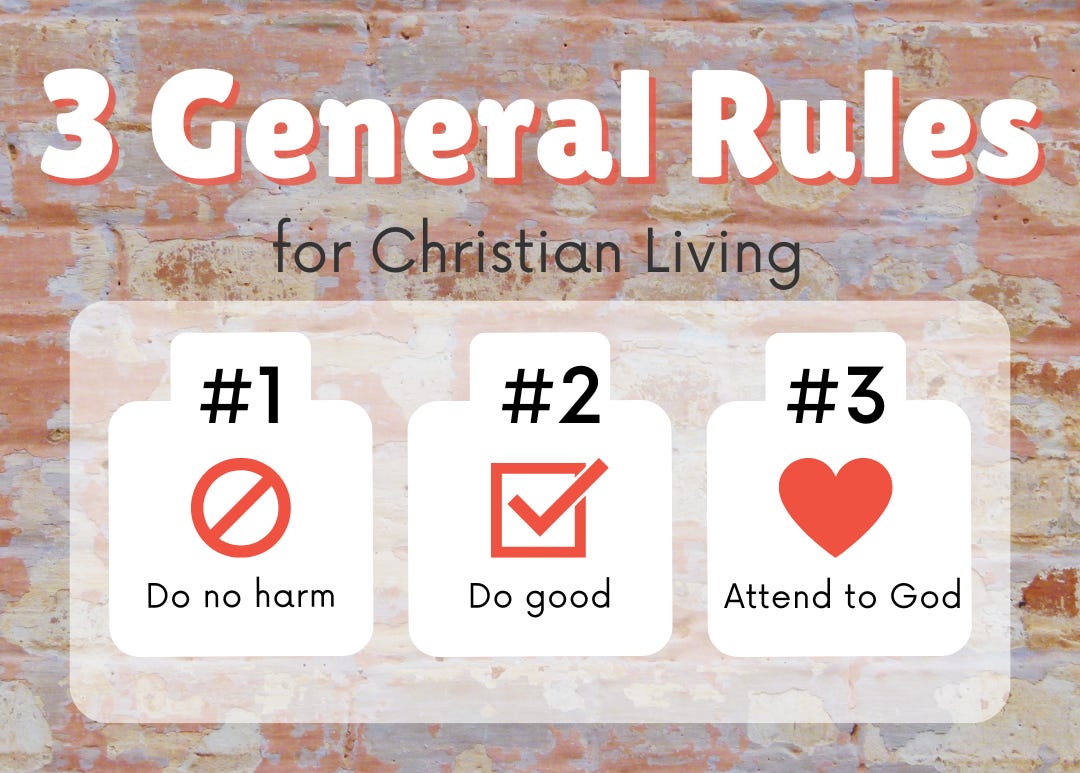
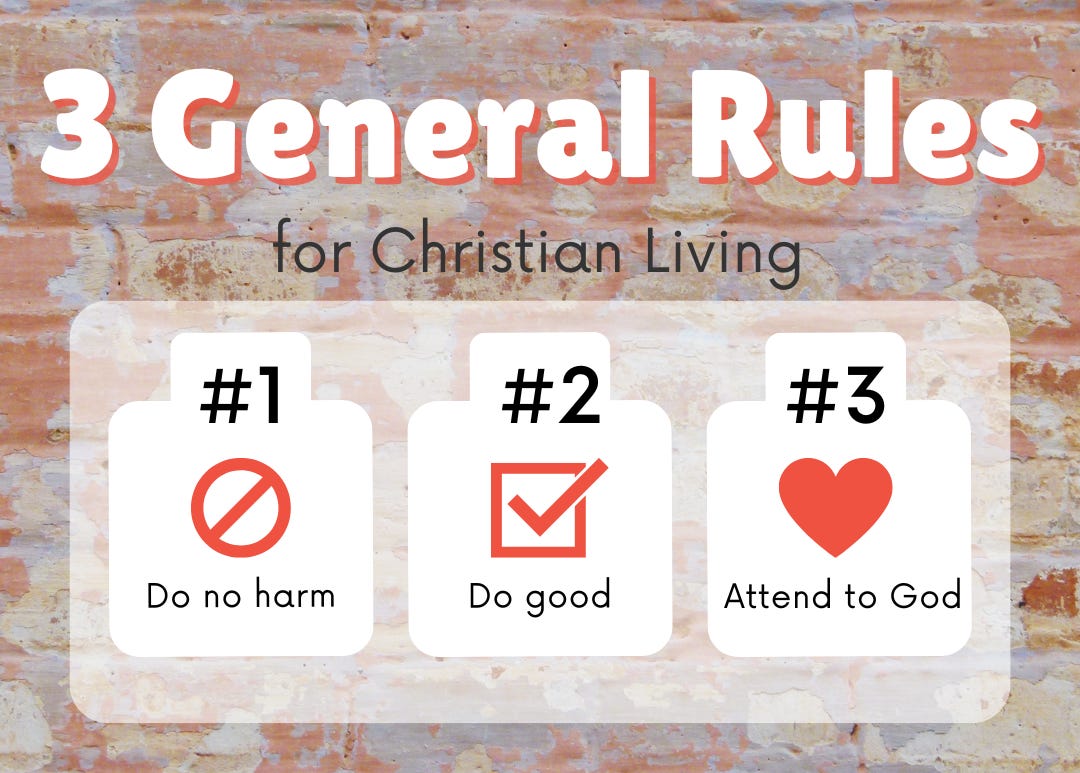
To be clear, one wasn’t expected to be already doing these things to get into a class. They weren’t the next step for people advanced in their spiritual journeys. Classes were for anyone with a desire to experience the saving grace of God. Once in these classes, members encouraged each other to make progress in:
Doing no harm
Doing good
Attending to the ordinances of God
That means that no matter how long it’s been since you’ve made a covenant with God – if you’ve been here for years or you’re just starting out – a small group and these three “General Rules” are what you need. All of us need a small group: a Sunday School class, a journey group, a UWF circle, a choir – some people to hold you graciously accountable to:
Doing no harm
Doing good
Attending to the ordinances of God
And when you do, here’s where you start:
Do no harm.
It’s weird to start with a negative, don’t you think? It’s not where I like to start. I like to start with the positive. “What are we celebrating?” “What do we hope for?” “What good do we want to do?”
But the truth is, in order to do good we start by stopping the harm.
It’s a triage approach to spiritual health. When a patient comes into the ER, there may be long-term issues that need to be addressed. To avoid winding up there again, they might need to change their diet, start exercising, try new medications… But before the doctor gets into any of that, they need to stop the bleeding. Stop the immediate causes of harm to the system first, and then introduce changes that do the body good.
The same is true for our spiritual system. In order for us to do good, we are wise to first stop doing harm – to ourselves and to others.
Perhaps this is why the 10 Commandments are mostly in the negative. Who looked it up? Who knows how many of the 10 Commandments are about things we’re not to do?
Eight! 8 out of 10 Commandments are “thou shalt nots.” Eventually we will want to move on from these. Eventually, we move on to “love God and love neighbor” and an infinite amount of good. But the 10 Commandments invite us to start here, with an inventory of what harm we might need to stop.
Wesley’s “General Rules” invite us to start there as well. In your bulletins you have printed his full list of examples of “harm” we ought to avoid. Some of them still ring true; others need some translation to apply to us today. But you might read them over and ask the Spirit to use them to reveal for you what harm you need to stop doing. Carefully pray over that – and find some people who will encourage you in that journey.
This is, after all, only the starting line. So get ready: there’s so much good to come.
Amen.
Find the video for this sermon online here.
Sermon Discussion Questions
John Wesley’s General Rules provide a framework for Christian living – what kinds of actions should result when we are following Christ. We’ll spend 3 weeks looking at all 3. Today we started with “Doing no harm, by avoiding evil o every king, especially hat which isms generally practiced.” To reflect on how this applies for you, review Wesley’s list below. Which examples of “harm” still apply today? Which need to be adapted from Wesley’s work in the late 1700s? What “harms” would you add to this list?
The taking of the name of God in vain.
The profaning the day of the Lord, either by doing ordinary work therein or by buying or selling.
Drunkenness: buying or selling spirituous liquors, or drinking them, unless in cases of extreme necessity.
Slaveholding; buying or selling slaves.
Fighting, quarreling, brawling, brother going to law with brother; returning evil for evil, or railing for railing; the using many words in buying or selling.
The buying or selling goods that have not paid the duty.
The giving or taking things on usury—i.e., unlawful interest.
Uncharitable or unprofitable conversation; particularly speaking evil of magistrates or of ministers. Doing to others as we would not they should do unto us.
Doing what we know is not for the glory of God, as:
The putting on of gold and costly apparel.
The taking such diversions as cannot be used in the name of the Lord Jesus.
The singing those songs, or reading those books, which do not tend to the knowledge or love of God.
Softness and needless self-indulgence.
Laying up treasure upon earth.
Borrowing without a probability of paying; or taking up goods without a probability of paying for them.
Daily Suggested Scripture Readings
Continue to reflect on the first general rule of “doing no harm” with these daily Scripture readings:
Monday: Deuteronomy 5:1-21
Tuesday: Galatians 5:13-26
Wednesday: Luke 14:25-35
Thursday: Romans 12:9-21
Friday: 1 Peter 3:8-12
Saturday: Luke 6:27-36